
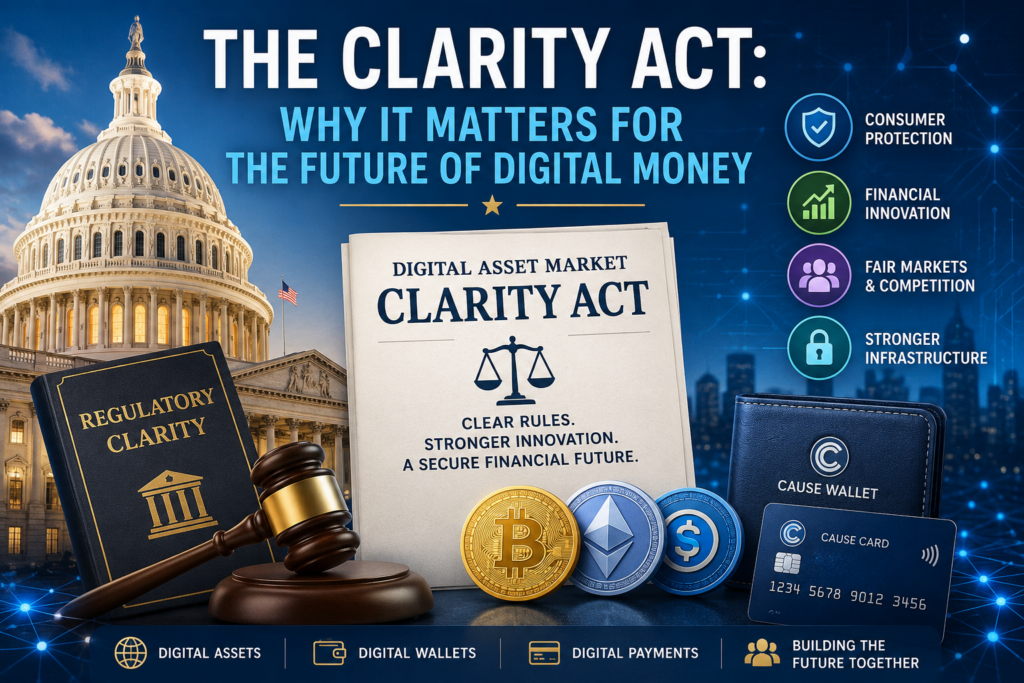

Have you heard of the CLARITY Act?
If not, you’re not alone.
While Congress has spent years debating cryptocurrency regulation, most Americans have never heard of the Digital Asset Market CLARITY Act. Yet this legislation could become one of the most important financial bills of the decade because it seeks to establish the rules for how digital assets, blockchain technology, and digital financial infrastructure will operate in the United States.
Whether you own cryptocurrency or not, the outcome of this legislation could influence the future of digital payments, online commerce, financial innovation, and the next generation of financial technology companies.
The CLARITY Act is not simply a cryptocurrency bill.
It is a bill about the future of money.
What Is the CLARITY Act?
The Digital Asset Market CLARITY Act was created to solve a problem that has frustrated regulators, investors, entrepreneurs, and technology companies for more than a decade.
Who regulates digital assets?
Since Bitcoin was introduced in 2009, regulators have struggled to determine whether cryptocurrencies should be treated as securities, commodities, payment instruments, or an entirely new category of asset. The result has been years of uncertainty, conflicting guidance, lawsuits, and regulatory confusion.
The CLARITY Act seeks to establish a framework that clearly defines which government agencies oversee various types of digital assets and under what circumstances those assets are regulated. Supporters argue that regulatory certainty will encourage innovation, protect consumers, and keep financial technology development within the United States rather than driving it overseas.
At its core, the legislation seeks to answer a simple but critically important question:
When is a digital asset a security, and when is it a commodity?
Understanding the Difference Between a Security and a Commodity
To understand why this distinction matters, it helps to understand the difference between these two classifications.
A security is generally an investment tied to the efforts of a company, management team, or organization. Stocks are securities because investors expect profits based largely on the work of a company and its leadership.
A commodity, on the other hand, is an asset that derives value from market demand, scarcity, or utility rather than the performance of a centralized management team. Gold, oil, wheat, and other raw materials are common examples.
Many digital assets exist somewhere between these two categories.
A new blockchain project may begin as a centralized effort led by founders, developers, and investors. Over time, however, the network may become sufficiently decentralized, allowing it to function more like a commodity than a traditional security. One of the primary goals of the CLARITY Act is to create a legal pathway that recognizes this evolution.
While that distinction may sound technical, it has enormous consequences. It determines which rules apply, which regulators have authority, how projects raise capital, and how consumers interact with digital assets.
This Bill Is Not Really About Bitcoin
Many media outlets describe the CLARITY Act as a cryptocurrency bill, but that characterization may actually be too narrow.
Bitcoin already has significant regulatory recognition and market adoption. The larger issue is not Bitcoin itself.
The real focus is the broader digital financial ecosystem that is rapidly emerging around blockchain technology.
This includes:
- Digital currencies
- Digital wallets
- Digital payment systems
- Tokenized commerce
- Blockchain-based financial infrastructure
In other words, the legislation is attempting to establish the rules for a future financial system that looks very different from the one most of us use today.
Just as the internet required new rules for digital communication and e-commerce, blockchain technology is forcing policymakers to consider how digital value should be created, stored, transferred, and regulated.
Where Cause Coin, Cause Wallet, and Cause Card Fit
This is where projects like Cause Coin, Cause Wallet, and Cause Card become relevant.
These initiatives exist within the exact environment the CLARITY Act seeks to regulate.
Cause Coin is a digital asset.
Cause Wallet is a digital wallet.
Cause Card is designed to operate within a digital payment ecosystem.
Each of these technologies represents a practical application of the infrastructure lawmakers are attempting to define.
If legislation such as the CLARITY Act becomes law, businesses operating within the digital asset space could gain greater certainty regarding compliance, consumer protections, reporting requirements, and operational standards. Regulatory clarity could make it easier for companies to build products, attract investment, establish partnerships, and scale their services with confidence.
For projects focused on long-term adoption rather than short-term speculation, clear rules can be just as valuable as technological innovation.
What Could Success Look Like?
If the CLARITY Act ultimately becomes law, several potential outcomes could emerge.
Entrepreneurs may have greater confidence launching blockchain-based businesses within the United States.
Investors could benefit from clearer disclosures and stronger consumer protections.
Financial institutions may become more willing to engage with digital asset companies once regulatory responsibilities are clearly defined.
Consumers could gain broader access to digital wallets, tokenized financial services, and blockchain-powered payment solutions.
Most importantly, innovation may accelerate as uncertainty is replaced with a more predictable regulatory environment.
For projects like Cause Coin, Cause Wallet, and Cause Card, a successful regulatory framework could help bridge the gap between emerging technology and mainstream adoption.
The Obstacles Ahead
Despite growing momentum, the CLARITY Act still faces significant challenges.
One of the largest sources of resistance comes from the traditional banking industry. JPMorgan Chase CEO Jamie Dimon recently stated that major banks will actively oppose portions of the legislation. At the center of the debate is whether crypto companies should be allowed to offer rewards or yield on stablecoin holdings without being regulated like traditional banks.
Banks argue that these programs effectively function like interest-bearing accounts while avoiding many of the regulatory requirements imposed on financial institutions. Crypto companies counter that such products increase competition, encourage innovation, and provide consumers with more options.
The dispute highlights a broader tension that often accompanies technological disruption. Established industries seek regulatory consistency and consumer protections, while innovators push for frameworks that allow new technologies to develop without being forced into outdated models.
Beyond banking opposition, the bill must navigate political negotiations, committee reviews, regulatory debates, and competing legislative priorities before it can become law. While many observers believe some form of digital asset legislation is inevitable, the final version of the CLARITY Act may look significantly different from the version being debated today.
Why This Matters Beyond Crypto
The most important takeaway may be this:
The CLARITY Act is not simply about cryptocurrency.
It is about defining the rules for a new layer of financial infrastructure that is being built around the world.
Whether the future includes digital currencies, tokenized assets, blockchain-based commerce, or entirely new forms of economic participation, governments will eventually establish rules governing how those systems operate.
The debate occurring in Washington today will help shape the environment in which tomorrow’s financial innovators build.
For entrepreneurs, investors, and consumers alike, this is a conversation worth paying attention to.
Because the question is no longer whether digital finance will become part of our future.
The question is what that future will look like once the rules are written.
Sources
- U.S. Senate Banking Committee, Digital Asset Market CLARITY Act Section-by-Section Summary.
- Reuters Legal, The CLARITY Act and the Future Digital Asset Market (March 31, 2026).
- Senate Banking Committee and Congressional market structure proposals regarding digital asset classifications and SEC/CFTC jurisdiction.
- Financial Services Committee, U.S. House of Representatives, Digital Asset Market Structure Legislation Hearings and CLARITY Act Proceedings.
- Yahoo Finance, Jamie Dimon Vows Banks Will Fight the CLARITY Act (2026).
- CoinDesk, Jamie Dimon Escalates Battle Over Stablecoin Rewards in CLARITY Act Debate (May 2026).
- Reuters, Yahoo Finance, and Senate Banking Committee materials regarding stablecoin yield provisions, banking industry opposition, and ongoing legislative negotiations.
- SEC and CFTC guidance regarding digital asset classifications, securities law interpretations, and digital commodity frameworks released in 2026.
- Congressional Research and market structure analyses discussing the transition of digital assets from securities to commodities as networks become decentralized.