
For nearly a century, the U.S. dollar has served as the foundation of the global financial system. It became more than a currency; it became the infrastructure of modern commerce itself. International trade, reserve banking, commodity markets, and global finance were all built around the assumption that the dollar would remain the central organizing force of the world economy indefinitely.
That assumption is no longer universally accepted.
This does not mean the dollar is collapsing, nor does it suggest the United States is suddenly losing its position as a major global power. But it does reflect a growing recognition that the architecture of global finance is beginning to change. Economic influence is becoming more distributed. Financial systems are becoming increasingly digital. And geopolitical power is no longer measured solely through military strength, but through technology, infrastructure, trade networks, artificial intelligence, and monetary systems themselves.
China’s rise illustrates this shift clearly. China has expanded global influence not primarily through military confrontation, but through manufacturing dominance, infrastructure investment, supply chain control, technological expansion, and long-term economic positioning. During a recent exchange with President Donald Trump, Chinese President Xi Jinping referenced the “Thucydides Trap,” asking whether China and the United States could avoid the historical tendency for conflict between rising and established powers. The Guardian coverage of Xi Jinping’s remarks
The significance of Xi’s statement extends beyond geopolitics. It reflects a broader reality that economic systems themselves are becoming the primary instruments of global influence.
A similar evolution is unfolding in the Middle East. Increasingly, geopolitical analysts argue that Iran’s leverage is not centered on conventional military victory, but on its ability to create economic instability within interconnected global systems. The Center for Strategic and International Studies recently described Iran’s broader strategy as “a war aimed at the global economy.” CSIS analysis on Iran and the global economy Through energy markets, shipping disruptions, inflationary pressure, and supply chain instability, economic systems themselves become the battlefield.
This matters because reserve currencies ultimately rely on confidence. Confidence in institutions. Confidence in governance. Confidence in long-term purchasing power. Confidence that the underlying system will remain stable, functional, and trusted.
When confidence fragments globally, diversification accelerates naturally.
That is one reason interest in blockchain infrastructure, decentralized finance, digital wallets, and borderless payment systems continues growing around the world. The appeal is not merely ideological or speculative. In many cases, it is structural. Younger generations increasingly operate in a world where commerce is global, transactions are instantaneous, work is remote, and digital systems feel more intuitive than traditional financial institutions designed for the industrial age.
Within that broader transition, projects connected to decentralized finance inevitably attract attention. But the more serious conversation is not about hype or speculation. The real question is infrastructure.
Throughout the history of technological transformation, the systems that survive are rarely the loudest. They are the systems that build durable infrastructure capable of supporting long-term participation and real-world utility.
That distinction is important when discussing ecosystems connected to Cause Vision and Cause Coin.
The long-term significance of any digital financial ecosystem is unlikely to depend solely on the existence of a token itself. It depends on whether there is an actual financial architecture surrounding it — systems capable of serving individuals and businesses in practical ways.
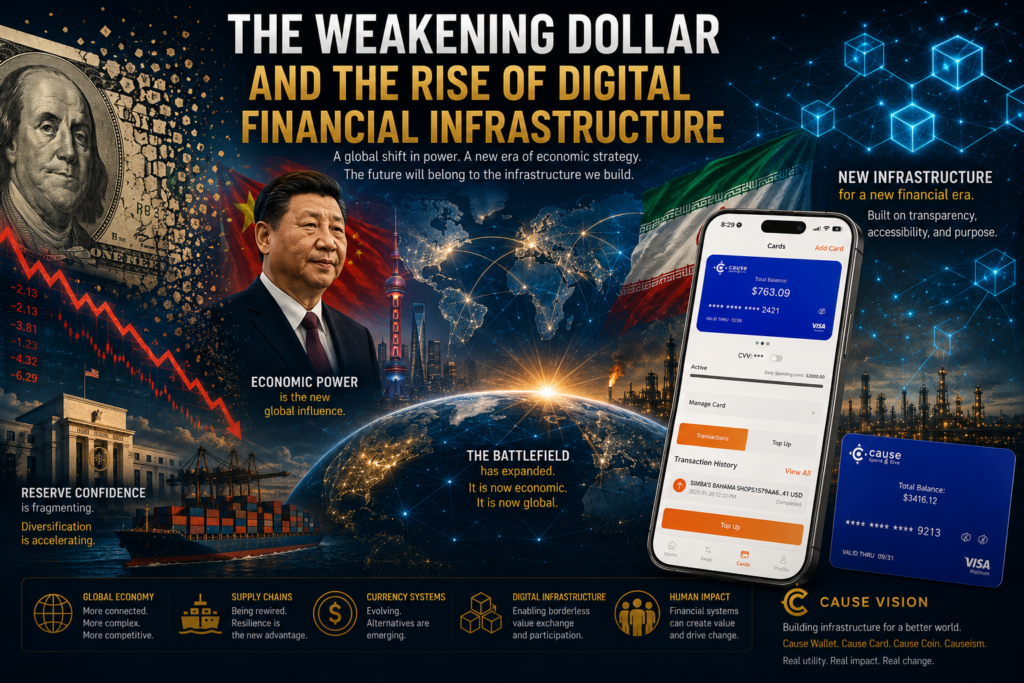
This is where utilities such as Cause Wallet and Cause Card become important to the broader conversation.
Cause Wallet is intended to function as a digital financial gateway capable of participating in an increasingly borderless economy. Cause Card extends that concept into everyday commerce by connecting transactions directly to the philosophy of transactional giving embedded within Causeism.
In other words, the larger vision is not simply the creation of another cryptocurrency.
The larger vision is the creation of infrastructure:
- payment systems
- digital wallets
- transactional ecosystems
- global participation tools
- and financial networks capable of integrating both commerce and social impact
Whether any particular platform ultimately succeeds remains uncertain, as with any emerging technology. But historically, infrastructure is what creates durability. Utility is what creates relevance. And systems that solve real-world problems tend to outlast systems built primarily around speculation.
What makes Cause Coin philosophically distinct is its connection to Causeism itself. Causeism attempts to explore whether financial systems can evolve beyond purely transactional economics and become vehicles for measurable humanitarian impact. Rather than separating commerce and giving into entirely different spheres, the philosophy asks whether financial participation itself can generate both economic value and social contribution simultaneously.
In that sense, the larger conversation is not merely about cryptocurrency.
It is about the future structure of trust.
The world appears to be moving toward a financial environment that is increasingly digital, globally interconnected, and less dependent on singular centralized systems. Whether that transition unfolds gradually or accelerates through geopolitical instability remains unclear. But the direction itself appears increasingly difficult to ignore.
The most important shift may not simply be the weakening of the dollar. It may be the emergence of a world in which financial systems compete not only on efficiency and scale, but on transparency, accessibility, participation, resilience, and purpose.