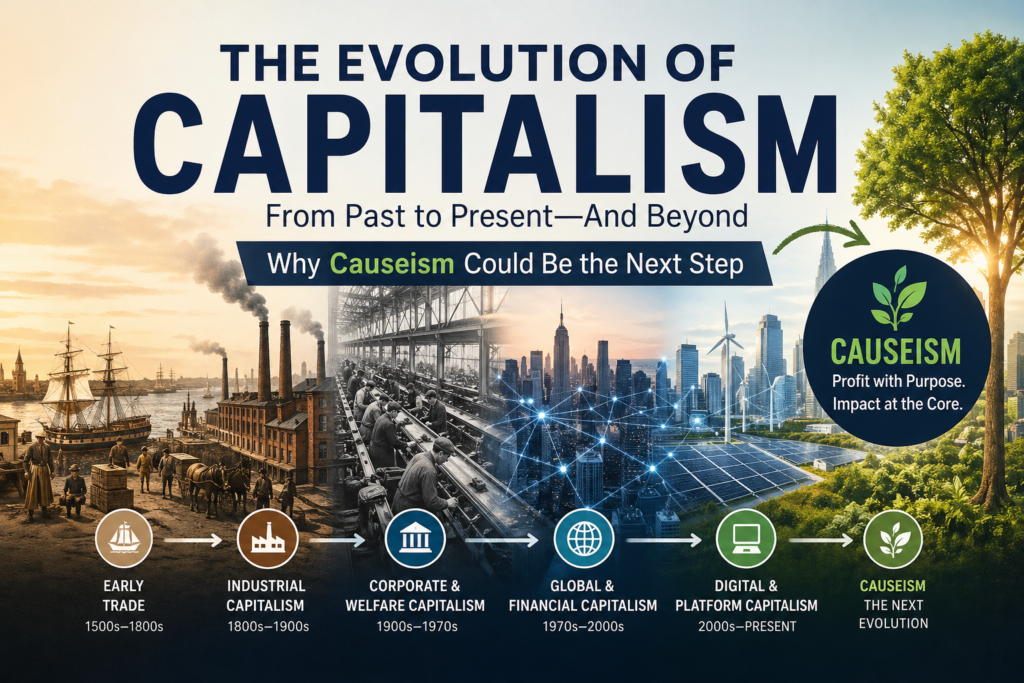

Capitalism didn’t appear overnight—and it hasn’t stayed the same.
From early trade systems to today’s global digital economy, capitalism has continuously evolved in response to technological change, social pressure, and economic crises (Heilbroner, 1985; Britannica, 2024).
Now, a growing number of thinkers and entrepreneurs are asking a new question:
What comes after capitalism?
One emerging idea is “Causeism”—a model where profit is aligned with purpose and measurable social impact.
To understand whether this is a real evolution or just a buzzword, we first need to look at how capitalism has changed over time.
What Is Capitalism? (Baseline Definition)
Capitalism is generally defined as an economic system characterized by:
- Private ownership of the means of production
- Profit-driven enterprise
- Wage labor
- Market-based exchange
(Britannica, 2024; Investopedia, 2023)
However, as many economists and sociologists note, this definition shifts depending on context (Stanford Encyclopedia of Philosophy, 2022).
Stage 1: Early Capitalism (1500s–1800s)
Often called merchant or commercial capitalism, this phase emerged alongside global trade expansion.
Key Features:
- Trade-driven wealth accumulation
- Colonial expansion
- Early financial systems
According to Weber (1905), cultural and religious shifts—particularly the Protestant ethic—helped legitimize profit-seeking behavior.
Limitation:
Economic activity was still limited in scale and not yet industrialized.
Stage 2: Industrial Capitalism (1800s–Early 1900s)
The Industrial Revolution transformed capitalism dramatically.
Key Changes:
- Mass production
- Factory systems
- Urban labor markets
Marx (1867) famously analyzed this phase, arguing that capitalism created structural inequality between capital owners and workers.
Key Tension Introduced:
Efficiency vs. worker exploitation
Stage 3: Corporate & Welfare Capitalism (1900s–Late 1900s)
In response to economic crises like the Great Depression, governments began intervening more actively.
Key Developments:
- Labor laws and worker protections
- Welfare systems
- Rise of large corporations
The International Monetary Fund notes that this period balanced market efficiency with social stability (IMF, 2020).
Shift:
Pure market capitalism → mixed economies
Stage 4: Global & Financial Capitalism (Late 1900s–2008)
This era saw rapid globalization and financial expansion.
Characteristics:
- Global supply chains
- Financial markets dominating economies
- Increased inequality
The World Bank highlights that globalization lifted millions out of poverty—but also widened wealth gaps (World Bank, 2022).
Emerging Problem:
Growth without equitable distribution
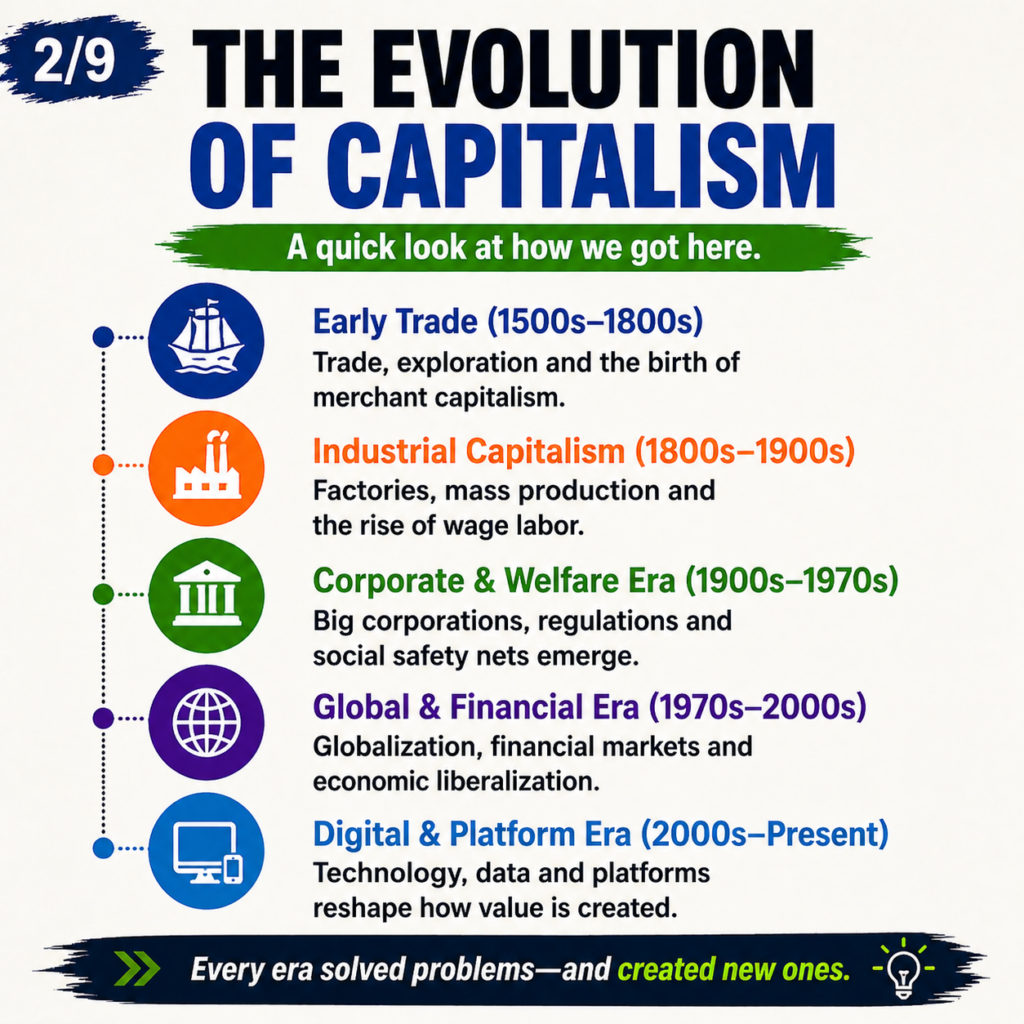
Stage 5: Digital & Platform Capitalism (2008–Present)
Today’s capitalism is increasingly driven by technology.
Key Features:
- Platform-based businesses (e.g., gig economy)
- Data as a core asset
- Network effects
However, critics argue this phase intensifies:
- Wealth concentration
- Market monopolies
- Labor precarity
(Srnicek, 2017)
The Core Problem Driving Change
Across all stages, one pattern repeats:
Capitalism evolves when its weaknesses become too large to ignore.
Current pressure points include:
- Inequality
- Environmental sustainability
- Lack of purpose in economic systems
These are exactly the concerns reflected in modern public discourse and research.
Enter “Causeism”: A Proposed Next Stage
“Causeism” is not yet a formal academic system—but it reflects a growing shift:
From profit-maximization → purpose-aligned value creation
Core Idea:
Businesses don’t just generate profit—they are designed to solve meaningful problems.
How Causeism Differs From Traditional Capitalism
| Feature | Capitalism | Causeism |
| Primary Goal | Profit maximization | Purpose + profit |
| Success Metric | Financial returns | Impact + financial sustainability |
| Business Role | Economic actor | Social problem-solver |
| Value Creation | Shareholder-focused | Stakeholder-focused |
Is Causeism Actually New?
Skeptically speaking—this isn’t entirely new.
Elements of Causeism already exist in:
- Social entrepreneurship
- ESG (Environmental, Social, Governance) investing
- B Corporations
However, these are often add-ons to capitalism, not replacements.
The real question is:
Can purpose become the primary driver, not a secondary feature?
Why Causeism Is Emerging Now
Three major forces are driving this shift:
1. Consumer Demand for Purpose
Modern consumers increasingly prefer brands aligned with their values.
2. Investor Pressure
ESG investing has grown rapidly, pushing companies toward accountability.
3. Systemic Limits of Capitalism
Issues like climate change and inequality require solutions beyond profit alone.
The Critical Challenge
Here’s the hard truth:
If Causeism cannot be measured, it cannot scale.
For it to become a true evolution (not just branding), it needs:
- Clear metrics
- Accountability systems
- Economic incentives aligned with impact
The Bottom Line
Capitalism has never been static.
It has evolved through:
- Trade
- Industry
- Welfare systems
- Globalization
- Digital platforms
Now, a new idea is emerging:
An economy where success is defined not just by profit—but by purpose.
Whether “Causeism” becomes the next stage depends on one thing:
Can it solve the problems capitalism couldn’t—without losing efficiency and innovation?
FAQ
What are the stages of capitalism?
Early, industrial, corporate/welfare, global/financial, and digital capitalism.
What comes after capitalism?
There is no universally agreed answer, but models like “Causeism” propose purpose-driven systems.
What is Causeism?
A proposed economic model where businesses prioritize both profit and measurable social impact.
Is capitalism evolving?
Yes. Historical evidence shows capitalism continuously adapts to social and economic pressures.
References
- Britannica (2024) Capitalism.
- Heilbroner, R. (1985) The Nature and Logic of Capitalism.
- International Monetary Fund (2020) Capitalism and Economic Growth.
- Investopedia (2023) Capitalism Definition.
- Marx, K. (1867) Capital.
- Srnicek, N. (2017) Platform Capitalism.
- Stanford Encyclopedia of Philosophy (2022) Capitalism.
- Weber, M. (1905) The Protestant Ethic and the Spirit of Capitalism.
- World Bank (2022) Global Economic Prospects.