

For decades, nonprofit organizations have carried the responsibility of addressing some of the world’s most pressing challenges. They serve vulnerable populations, strengthen communities, and provide hope where it is often in short supply. Yet despite the importance of their work, most nonprofits operate in a constant state of uncertainty. The issue is not a lack of passion or purpose—it is a lack of predictable, sustainable funding.
Throughout my career, I’ve had the opportunity to work alongside nonprofit organizations and witness both their impact and their struggles. What stands out is not the dedication of the people involved, but the system they are forced to operate within. Too often, leaders of these organizations spend the majority of their time not on fulfilling their mission, but on securing the resources needed to sustain it. Fundraising events, grant applications, and donor outreach become the primary focus, leaving less time and energy for the work that truly matters. It is not uncommon for organizations with powerful missions to fall short simply because the funding model itself is unstable.
The traditional nonprofit model relies heavily on donations, grants, and periodic campaigns. While these sources can be meaningful, they are often inconsistent and unpredictable. Giving becomes occasional rather than continuous, reactive rather than integrated. As a result, when funding slows down, so does impact. This is not a reflection of the value of the mission—it is a reflection of the limitations of the system.
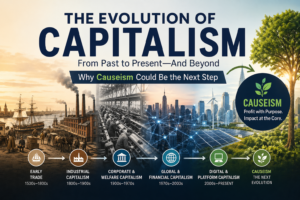
I believe there is a better way forward. Causeism introduces a model where nonprofits are no longer dependent on sporadic generosity but are supported through consistent economic activity. At its core, Causeism creates a direct and ongoing relationship between for-profit businesses and nonprofit organizations. A percentage of revenue is built into every transaction, ensuring that giving is not delayed or conditional, but embedded into the very structure of commerce.
This shift has profound implications. When funding becomes consistent, nonprofits gain the ability to plan, grow, and scale their impact with confidence. The conversation moves away from survival and toward expansion. Leaders are no longer forced to ask whether they will have the resources to continue their work—they can begin focusing on how to deepen and extend it.
What this ultimately creates is a transition from fundraising to fulfillment. When nonprofits are supported through a stable and predictable model, they are freed to concentrate on the communities they serve. They can invest in long-term solutions, refine their programs, and deliver more meaningful outcomes. The energy that was once spent chasing funding can now be directed toward creating lasting change.
Causeism also redefines the relationship between business and nonprofit organizations. Instead of one-time donations or transactional partnerships, it fosters long-term alignment. Businesses and nonprofits grow together, connected by a shared purpose. The success of one directly contributes to the success of the other. In this model, nonprofits are no longer positioned on the periphery—they become an integral part of the economic system itself.
The ripple effects of this shift are significant. When nonprofits have reliable support, communities become stronger, families gain stability, and opportunities expand. Perhaps most importantly, trust begins to return. People start to see that business can be a force not only for profit, but for meaningful, consistent good.
At its core, Causeism is about creating a more human-centered economy—one where impact is not an afterthought, but a built-in outcome of everyday activity. It represents an evolution in how we think about both business and giving, aligning the two in a way that benefits everyone involved.
Nonprofits will always play a critical role in shaping a better future. But if we want them to succeed at scale, the way we support them must evolve. We cannot continue expecting stable outcomes from unstable systems. Causeism offers a path forward—one where nonprofits are not just supported, but empowered.
I have seen what happens when purpose and profit are aligned. Businesses become stronger, people become more engaged, and communities begin to transform. But one of the most meaningful outcomes is this: nonprofits are finally given the foundation they need to do what they were created to do.
And when that happens, the impact extends far beyond any one organization—it reaches all of us.